Articles
What is the Philosophy of Macrobiotics?
Beginning Series, Part 5
from Macrobiotics Today, September/October 2008
Julia Ferré
Philosophy is the driving force behind macrobiotics. It provides meaning for how to live, inspiration to change perspective and habits, and impetus to do certain things and to avoid other things. It may seem—at first glance—that macrobiotics is only about diet, yet macrobiotics is more than food just as yoga is more than exercise. Yoga and macrobiotics are similar; both are disciplines that help people, both require regular practice, and both stem from a philosophy—a way of looking at life. Yoga has its roots in the wisdom of India; Macrobiotics has its roots in Far Eastern philosophy.
Macrobiotics receives its inspiration from George Ohsawa—a Japanese man born in 1893. Ohsawa had a difficult childhood; he witnessed his mother and brother dying from tuberculosis and contacted the disease himself as a teenager. He searched for a cure, found it, healed himself, and began a career to impart the lessons he learned. Ohsawa lived at a crucial time in history when ideas and practices from the Far East were first spreading to Europe. He traveled extensively, wrote prolifically, and taught and encouraged people globally. His range of subject matter included speaking out against World War II, teaching people about yin and yang, and offering advice for daily living. Some consider him a political activist; others a fatherly role model; others an instigator of change. Ohsawa’s life encompassed many aspects and all of his books contain gems of wisdom.
Even so, some people ask, “Why bother studying Ohsawa?” There is some resistance to his teachings and even some aversion. Literal readings of some of his writings reveal a side of Ohsawa that seems harsh, critical, and rule-bound. For example, Ohsawa’s statements about homosexuality and women’s appearance and roles alienate many people today, even with the understanding he was echoing perceptions of his time. His writings of mundane things such as the number of times a day that a person goes to the bathroom or his presentation of various diets seems like nothing more than lists of rules that stress right and wrong. The fact that he includes treatments and recipes appears to take him out of the sage/philosopher model. Compare him to the yoga teacher Patanjali or the Chinese sage Lao Tsu, and Ohsawa’s stature lessens.
However, Ohsawa addresses an issue that Patanjali and Lao Tsu do not, specifically the association between health and judgment—Ohsawa’s term for the ability to reason, think, and hopefully understand Infinity, Freedom, the Tao, or whatever name you want to call the Source. Ohsawa was first and foremost concerned that people learn to love life and to be free in their thinking; he felt that because so many people were in a state of poor health, they were less able and less inclined to study and understand philosophy.
Ohsawa contributed to the field of health and spiritual studies. His writings, teachings, and life inspired many predominant people, including Michio Kushi and Herman Aihara, who in turn influenced countless students of their own. Modern-day macrobiotics owes a lot to Ohsawa, and a lot can be learned from reading any of his books.
This article features Ohsawa’s books. Below are twelve of his works in English presented in the order Ohsawa wrote them.
UNIQUE PRINCIPLE: PHILOSOPHY OF MACROBIOTICS, 1929
Ohsawa traveled to France in 1929 and was charmed by the culture; in return, he sought to introduce Far Eastern philosophy to the French. This is his first book for Westerners. Many people helped in the translation to English.
Herman Aihara says in the foreword, “This is a great book for people who wish to study Eastern philosophy and its application in the various fields of science. However, the most important contribution…is…that it will lead people to a better and deeper understanding of the principles on which Eastern religion, morals, character, living customs, and science are based. And this…in turn will help people to lead happier and healthier lives.” (page 3)
The Unique Principle discusses Eastern thought, including chapters on Chinese Science (Chemistry, Biology, Physics, Mathematics), a brief chronology of ancient Chinese philosophers, an explanation of the 8 trigrams that comprise the I Ching, and comparisons between the spirit of the Asian people, specifically the Chinese, the Hindu, and the Japanese.
Here is a quote from page 54: “The only law of Chinese Medicine is explained in four words, Shin do fu ji which means man is the result of his environment.”
This book is currently available as a study edition from the George Ohsawa Macrobiotic Foundation.
THE ORDER OF THE UNIVERSE, 1940
This book is unique among George Ohsawa’s books because of its multi-lingual origins. Originally written in Japanese, it was translated to French, and then to Spanish. Jim Poggi translated from the Spanish edition under Herman Aihara’s auspices and added extensive notes to help elaborate Ohsawa’s thoughts.
The Order of the Universe is a book of 100 pages and is a short treatise on how there is order in the universe; specifically how there is an infinite world and a finite world and how they are related. This philosophical discussion includes maps illustrating these worlds and how this order relates to humans. Also included is an essay by Herman Aihara titled, “The Spiralic Concept of Man” that shows an application of this order.
MACROBIOTIC GUIDEBOOK FOR LIVING AND OTHER ESSAYS, 1947
Macrobiotic Guidebook for Living is a book of practical teachings such as love, marriage, family, sickness, and old age. For the most part it is George Ohsawa’s invitation to be thorough and demanding in one’s life to help create joy and happiness. However, there are statements in this book that have been quoted and denounced. Some people give up on Ohsawa due to declarations such as, “I am convinced that a sick man is a criminal and that sickness is his punishment.” (page 45) Or, “The woman who does have a painfully difficult delivery has been eating incorrectly; the child born of such a delivery may very likely be an unhappy one.” (page 23)
What can I say? I am a woman. I don’t agree with these views, yet, I still find value in studying Ohsawa. In my opinion, his message is one of perseverance and potential; and overall, I think there is more in this book that is helpful than not. On page 47 Ohsawa furthers the thought started on page 45, “True health is that which you yourself have created out of illness. Only if you have produced your own health can you know how wonderful it actually is.”
Herman Aihara translated this book from Japanese and Paula Markham worked on the revised edition in 1985.
THE BOOK OF JUDO , 1952
This book was also published as, The Art of Peace. Herman Aihara says on page 3, “Ohsawa’s The Art of Peace is a guiding light showing the causes of war and the way to establish true peace, spiritually and physically, starting from the individual…I think this is one of Ohsawa’s greatest books.” While Ohsawa explains the ideas of judo and aikido and talks of war and “war-like” mentality, the thrust of this book is on how to strengthen internal fortitude to establish peace in oneself, which in turn leads to peace in the world, and to eternal peace.
Here is a quote about the Principles of Judo:
“The essential principle of judo is derived form Chinese military strategy: ‘The flexible conquer the strong and hard through the use of suppleness.’ This phrase recalls to us the four following lines of the celebrated philosophy of military strategy.
“The one who is flexible on the outside and firm on the inside will continuously prosper.
“The one who is strong on the outside and weak on the inside will prosper initially but eventually diminish.
“The one who is flexible on the outside and weak on the inside will lose whatever one has inevitably.
“The one who is hard on the outside and strong on the inside will be destroyed sooner or later.” (pages 62 to 63)
Ohsawa wrote this book around 1950 in Japan. It was published in France in 1952. William Gleason translated it from Japanese into English in 1990.
GANDHI, THE ETERNAL YOUTH, 1954
Ohsawa wrote this book in the seven to eight days that it took to travel to India from Japan. Ohsawa wrote about Gandhi to encourage young and poor people to overcome obstacles and strive to be great. The book concentrates on Gandhi’s youth and upbringing and the character traits that tempered his ideology to become one of the world’s greatest leaders. Ohsawa quotes from M.K. Gandhi’s Autobiography and comments about struggles Gandhi had with honesty, theft, and conquering temptation. Some of the chapter titles are: “Gandhi’s Secret,” “Gandhi’s Greatest Crime,” and “Gandhi’s Faith is Tested.”
Ohsawa writes: “Is it because Gandhi was a great saint that he was so widely admired? Or because his accomplishments were on such a vast scale that even those of Jesus and Buddha pale in comparison? No. The universal admiration for Gandhi rests on a much less glamorous aspect of his character. To the very end he was a man of total self-reflection. He saw, despite the praises of others, that he was absolutely insignificant and worthless.
“It is curious and paradoxical, but the greatest man of this world is the one who knows that he is the biggest criminal, the most foolish and pitiful, the ugliest one of all. Admiration is all the greater and more merited if the admired person is fully aware of his own defects.” (page 123)
Originally published in Japanese in 1954, this book was translated into French and later into English in 1986. English translator, Kenneth Burns, says on page 130, “…I read some of the other works on Gandhi, in order to acquaint myself more fully with the details of his life, and in order to see him from the viewpoint of other writers. I have come to the conclusion that in this relatively short work Ohsawa has given us the essence of Gandhi.”
PHILOSOPHY OF ORIENTAL MEDICINE, 1956
“Ohsawa completed this work in 1956 while in Africa, in order to explain Oriental medicine and philosophy to Dr. Albert Schweitzer.” (back cover)
Ohsawa writes in the preface, “My purpose in writing has been:
“(1) To present the Unique Principle—the dialectical, universal, simple, useful foundation of science and philosophy of all great religions and of all Far Eastern civilization;
“(2) To show the biological, psychological, medical, educational, sociological and logical application of the Unique principle;
“(3) To represent Far Eastern medicine (in particular) in the light of the Unique Principle;
“(4) To reveal the Unique Principle in all its glory as the principle of infinite freedom and eternal peace.
“The Unique Principle of the Far East is exceedingly simple and extraordinarily practical. Anyone can understand it in a few hours and use it immediately in everyday life because it embraces the universal logic, dialectics. It is a very practical universal compass.
“According to the Unique Principle, the greatest thing in life is faith. Internally, this faith is clairvoyance (the opposite of credo quia absurdum est—the belief in something sheerly because it is so incredible), which clearly sees and comprehends everything through infinite time and space. Externally, it is a manifestation of universal love or supreme judgment, embracing all antagonisms and transforming them into oneness, distributing the eternal joy of life to all, forever.” (pages 1 to 2)
Philosophy of Oriental Medicine is one of the classic books in macrobiotic literature. In it, Ohsawa defines the Unique Principle—also called yin and yang—and provides reasons why he classifies yin and yang the way he does. Also included is a section on understanding and developing personal judging ability and case histories of people Ohsawa saw in India and Africa.
For a number of years in the 1960s and 1970s The Philosophy of Oriental Medicine was published as The Book of Judgment.
ZEN MACROBIOTICS, 1960
Zen Macrobiotics is the book Ohsawa wrote in English for Americans. The 3rd edition, published in 1965, became famous as the Little Black Book with the Red Circle on the Cover. Widely distributed, many people learned of macrobiotics due to this book, and even today, many people associate macrobiotics (and limit it) to the terms of this book.
Zen Macrobiotics contains a summary of Ohsawa’s thoughts of Far Eastern Medical philosophy as well as his practical suggestions for food, cooking, and treatments. The 4th edition is currently available and contains all of the information from the previous 3rd edition, as well as recipes that were in Ohsawa’s original edition.
This book is concise. The appendices on pages 190 to 193 conveniently place several lists together: the seven laws of the universe, the twelve theorems of the unique principle, the seven stages of judgment, and the seven stages of illness.
CANCER AND THE PHILOSOPHY OF THE FAR EAST, 1963 (FIRST ENGLISH EDITION, 1971)
“In Cancer and the Philosophy of the Far East, Ohsawa begins with an account of his 1955 visit to Schweitzer’s hospital in Africa and of how he discovers the cure for deadly tropical ulcers; which leads into his teachings on the physical and mental aspects of disease, the traditional approach to healing versus the symptomatic medicine of today and the principle of yin and yang—the foundation of macrobiotics.” (back cover)
Herman Aihara writes in the preface, “Ohsawa learned both Oriental and Western approaches to health…in this book, he is offering advice on the cure of cancer from the Oriental medical point of view. However, this is not the cancer cure book that most people would imagine, but rather it is a spiritual book on how to overcome the fear of incurable diseases, of which cancer is one.”
This book was formerly titled: Macrobiotics: The Way of Healing; and it is an amazing combination of practical and philosophical teachings. Ohsawa believed in the power of macrobiotics to heal people—not only in the body, but also in the spirit. To appreciate the following quote, understand that Ohsawa defines the term “justice” not as “punishment,” but as “Absolute Justice, or the basis of all existence,” also called the Tao, Infinity, or the Order of the Universe—another of Ohsawa’s favorite terms.
Ohsawa writes, “The following rules can serve as guideposts on the journey towards the comprehension and practice of justice for man.
“Never get angry. Accept everything with unlimited joy and gratitude, even if it be extremely humiliating, painful, or the cause of great inconvenience. Accept terrible misfortune or deep anxiety with ever-growing thankfulness. Maintain yourself in such a condition that from morning till evening the words flowing out of your mouth reflect infinite gratitude.
“Never know fear. With a mental attitude that is fully prepared to accept whatever happens, seek what is horrible, repugnant or fraught with hardship.
“Never say, ‘I am tired; I am in trouble; it is difficult; what can I do?’ or any similar expression.
“While eating anything, keep repeating, ‘What a joy, how delicious!’
“Sleep soundly and peacefully. Never dream, never move. Be content with four or five hours of sleep, awaking with a smile and at the designated time.
“Never forget anything—especially the spirit inherent in the maxim, ‘From one grain, ten thousand grains.’
“Never lie to protect your ‘self.’
“Be precise.
“Like everyone equally.
“Never doubt others.
“Attach yourself completely and solely to Absolute Justice, the Order of the Universe (change itself, the only constant).
“Discover and contemplate what being alive really means; understand that life is the most precious and greatest treasure in the world.
“Hour after hour, day after day, enjoy the pleasure and thrill of discovering the sublime Order of the Universe.
“Never work. (Never sell your time or your life, for money.) Amuse and enjoy yourself to the end. Every day, all your days, live as a free man, the way the birds and the fish do in the skies and rivers.
“Live the principle, ‘From one grain, ten thousand grain,’ by distributing joy and thankfulness to everyone you meet. (pages 135 to 137)
YOU ARE ALL SANPAKU, 1965
You Are All Sanpaku is a classic bestseller that introduced macrobiotics to the field of alternative health. Translated by William Dufty, it also includes his remarkable transformation due to macrobiotics and established him as a respected teacher. Later he wrote Sugar Blues—another best-selling book.
Ohsawa writes, “The Japanese word Sanpaku translated literally means three (san) whites (paku). The sense of the word is a condition of the human eye that presents three white sides or areas around the iris. In a healthy newborn child, the lower edge of the iris—the sphere of color at the center of the eye—rests below the lower eyelid like a rising sun. The eye has two white areas on either side of the iris. In the eyes of a dead man, the iris turns up into the skull. If it is visible at all it has three white sides. Sanpaku. As a man becomes old or ill, as he approaches death—whether he be seven years old or seventy—the colored portion of the eye—the iris—rises to disclose white between the lower lid and the iris.
“This is the condition known for thousands of years as Sanpaku. For thousands of years, people of the Far East have been looking into each other’s eyes for signs of this dread condition. Any sign of Sanpaku meant that a man’s entire system—physical, physiological and spiritual—was out of balance He had committed sins against the order of the universe and he was therefore sick, unhappy, insane, what the West has come to call “accident prone.” The condition of sanpaku is a warning, a sign from nature, that one’s life is threatened by an early and tragic end…There is a remedy. It is to be found in a philosophy and a system of restoration through food…I call it macrobiotics.” (pages 70 to 71)
MACROBIOTICS, AN INVITATION TO HEALTH AND HAPPINESS, 1971
This small book condenses a lot of information in a short number of pages. Pages 1 to 19 are attributed to George Ohsawa; pages 20 on are compiled and written by Herman Aihara—recipes by Cornellia Aihara.
Ohsawa writes: “It seems to me that man’s ultimate desire is happiness. I rarely find a person, however, whose life is really happy….My aim in writing this small booklet is to introduce you to the way of eating and selection of foods which will eventually lead you to true, eternal happiness.” (page 1)
This book contains many lists—from Buddha’s eight types of sufferings to the seven levels of judgment, to steps to starting the macrobiotic diet. Most of these topics are elaborated in other books by Ohsawa; yet this book remains a valuable introduction to the scope of Ohsawa’s teachings.
PRACTICAL GUIDE TO FAR EASTERN MACROBIOTIC MEDICINE, 1976
“This book, a compilation of several books and writings of George Ohsawa, attempts to give the whole scope of macrobiotics medicine to everyone. The main part is treatment for sickness. However, treatment without understanding of principles and a good attitude is dangerous; therefore, the theory of macrobiotics and other articles were added.” (page vii of the Foreword)
This book covers a wide scope of information concerning aspects of macrobiotics and healing. Chapters include Yin-Yang, Physiognomy, Cooking for the Sick, and Lima Ohsawa’s Hand Healing and Massage. One section of the book lists sicknesses from head to foot: however, the list is not complete. There is an eye-opening chapter on Ohsawa’s personal experience of how he dealt with severe pain and the lessons he learned.
This book has much to offer considering the date of publication. The copy I reviewed was a photocopy. The George Ohsawa Macrobiotic Foundation will reissue this classic later this fall or early in 2009.
ESSENTIAL OHSAWA, 1994
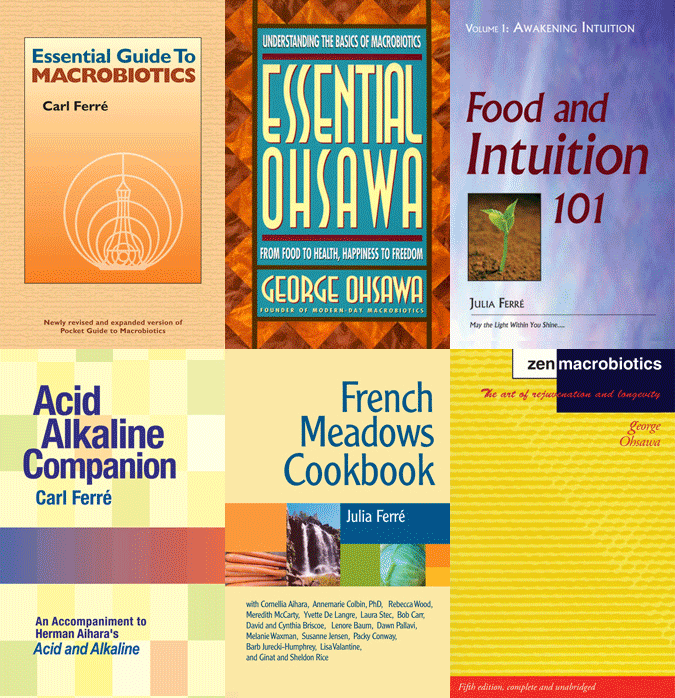
Essential Ohsawa is an anthology of Ohsawa’s work. It is similar to the “greatest works of…” where the publisher (in this case Carl Ferré) organizes all the best material from the various sources and prints it into one volume.
Essential Ohsawa is organized in three main parts (body, mind, and spirit), contains a chronology of Ohsawa’s life, a list of his writings (titles in English, French, and Japanese), and photos and remembrances.
Part One—Foundations of the Body—begins with this quote, “Let us make our bodies healthy with righteous food. We can thus enter into the miracles of the universe and enjoy a profound eternal life.” (page 9)
Part Two—Principles of the Mind—starts thus, “Happiness or misery, health or sickness, freedom or slavery—all depend upon the manner in which we conduct our daily lives and activities. Our conduct is dictated by our judgment. It, in turn, is a result of our comprehension of the structure of the world and the infinite universe.” (page 71)
Part Three—Dreams of the Spirit—states, “The physical life is the false one. One hundred years of it are as nothing. It is the spiritual life that is real—one instant of it is priceless.” (page 153)
Many people consider this book to be the must-read book of and about Ohsawa. For some, it is because it is yang—the book is concise and to the point and emphasizes Ohsawa’s core teachings. Other people consider it yin—the book is expansive in that it illustrates the scope of Ohsawa’s thought. (For example, it includes Ohsawa’s list of suggested books, from the I Ching to the Vedas to the writings of Darwin and the classics of Shakespeare.) Still other people consider it balanced, complete—it lays out all of Ohsawa’s major teachings from body, mind, and spirit, to the emphasis on finding joy in life. Almost everyone agrees that if you read only one book on Ohsawa, choose this one.
The book concludes with these words from a play George Ohsawa wrote for children, Magic Spectacles.
“No precisely-produced camera can compare with your eye.
“No airplane, jet, or atomic-powered engine can compare with your heart.
“No great building can compare with your body cells.
“The most important thing to do is to clear up the clouds in your thinking or judging ability.
“This is the aim or goal of my teaching.
“The world is big.
“You are young.
“There are many places to go; there are many thing to do.
“The only thing you need is health.
“If you know the secret of health and observe it, then you will gain freedom and independence.
“How wonderful life is if you apply this principle of life by yourself.
“Life becomes more interesting than the adventures of Tom Sawyer.
“You can do anything you want to do all of your life.
“What a great life lies before you!” (page 212)
Julia Ferré is author of Basic Macrobiotic Cooking: 20th Anniversary Edition, French Meadows Cookbook, and plans the menus at the French Meadows camp.
George Ohsawa Macrobiotic Foundation, PO Box 3998, Chico, CA 95927-3998—530-566-9765; Fax 530-566-9768 29 Order: 1-800-232-2372; This email address is being protected from spambots. You need JavaScript enabled to view it.